Warpath Universe: Wing Commander Silas Vance
18th Nov 2026
Cleric

Welcome back! Today as part of our ongoing Global Campaign build up, we're introducing an entirely new character to the Warpath Universe, and soon to be usable model in Firefight - Wing Commander Silas Vance.
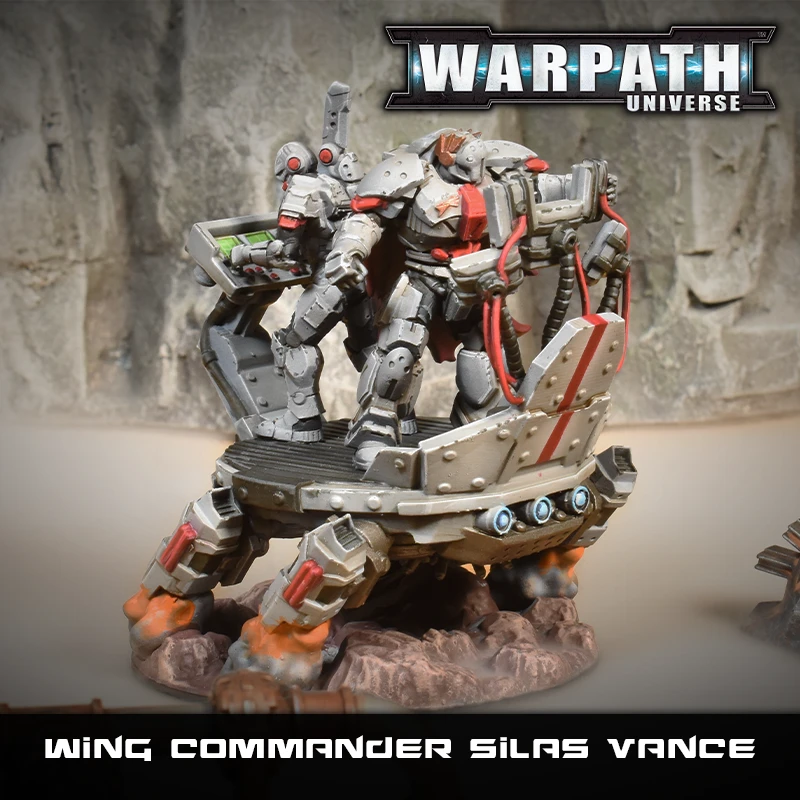
Silas Vance, Enforcer Wing Commander
While Strike Teams fight through shattered streets and breach enemy strongholds, the fate of entire worlds is often determined hundreds of kilometres overhead, amidst the cold darkness of orbit. It is here that Wing Commander Silas Vance has earned a reputation as one of the Corps' most capable fleet officers.
Born on the heavily industrialised world of Kestral Prime, Vance was originally earmarked for service within the Enforcer Navy's strategic planning division. His aptitude scores revealed an exceptional ability to process vast quantities of tactical data simultaneously, identifying patterns and opportunities invisible to others. During simulation exercises, instructors noted that Vance could track dozens of independent engagements at once while maintaining near-perfect prediction accuracy. Rather than assigning him to a command vessel, the Corps selected Vance for the highly specialised Wing Commander programme.
For over two decades he served aboard Enforcer battlefleets operating throughout GCPS controlled space. Pirate interdictions, border disputes, Plague containment actions, and suppression campaigns against insurgent movements all contributed to an operational record distinguished by a remarkable statistic: no fleet under his direct coordination had ever suffered a catastrophic command failure. Among GCPS Commanders, Vance became known as "The Surveyor."
The nickname was not intended as praise. Critics initially used it to mock his methodical nature and apparent reluctance to act on instinct. Yet campaign after campaign demonstrated the effectiveness of his approach. Where others relied upon intuition, Vance relied upon certainty. Every firing solution, every deployment corridor and every orbital insertion was calculated, cross-referenced and verified. By the time he gave an order, the outcome was often all but inevitable. This reputation eventually brought him to the attention of the Enforcer High Command's Strategic Operations Directorate.
As conflicts across the Outer Spheres intensified, the Directorate required commanders capable of integrating fleet operations directly with ground actions. Vance was among the first selected to deploy planet side aboard the newly developed Minerva mobile command platform. Unlike conventional command vehicles, the Minerva was effectively a fragment of an orbital command centre brought to the battlefield. Protected by reinforced armour and experimental shield technology, the platform served as a nexus for satellite feeds, fleet telemetry, reconnaissance reports and battlefield communications. Through its systems, Vance could observe conflicts unfolding simultaneously in orbit and on the surface below.
His role was simple in theory.
Ensure that every asset under his command was in precisely the right place at precisely the right time. In practice, this meant coordinating orbital bombardments to within metres of friendly positions, adjusting fleet manoeuvres in response to changing ground conditions and directing precision strikes against targets that existed for only moments before vanishing beneath cover. Such operations demanded constant collaboration with battlefield specialists.
Vance developed a particular preference for working alongside veteran strike sergeants and Forward Observers, valuing their practical experience over the detached assessments of remote sensors. Numerous officers have served as his adjutants over the years, and many describe an unusual command relationship. Vance neither dominates discussions nor tolerates unquestioned assumptions. Instead, targeting solutions become a process of rapid refinement, commander and adjutant exchanging corrections and calculations until the final seconds before firing.
Several of the Corps' most celebrated orbital strike operations bear his signature.
During the Cleansing of Helios Reach, Vance coordinated simultaneous fleet engagements against a Marauder fleet while directing precision lance strikes against ground-based anti-orbital batteries. At the height of the operation, he reportedly adjusted a firing solution less than three seconds before impact, shifting the strike by only a few metres. The resulting bombardment destroyed the target battery while leaving an advancing Enforcer platoon unharmed.
To Vance, the action was unremarkable.
"The correction was necessary," he later stated in his official report. "Failure to implement it would have reduced operational efficiency."
Those who know him suspect this was not modesty, but simple truth.
Silas Vance possesses little interest in glory, politics or personal recognition. He views warfare as a mathematical problem to be solved, a system of variables that can be understood and controlled through sufficient discipline and preparation. While some Enforcers become legends through acts of courage, Vance has become one through precision. Adorned with refinery reserved for the highest ranks, Silas silently scorns the ceremony of the role but understands its value for inspiration. When his Minerva platform appears on the battlefield, allies take confidence and enemies seek cover.
Both understand the same reality.
Somewhere above them, an Enforcer fleet is waiting.
And Wing Commander Silas Vance already knows exactly where its guns need to fire.
The Magnus Breach
The Magnus Breach is too vast for any single fleet to patrol, too volatile for any governor to control, and too important for the Council to lose. For that reason, overall strategic coordination of Enforcer and GCPS military operations throughout the sector has been entrusted to one officer: Wing Commander Silas Vance.
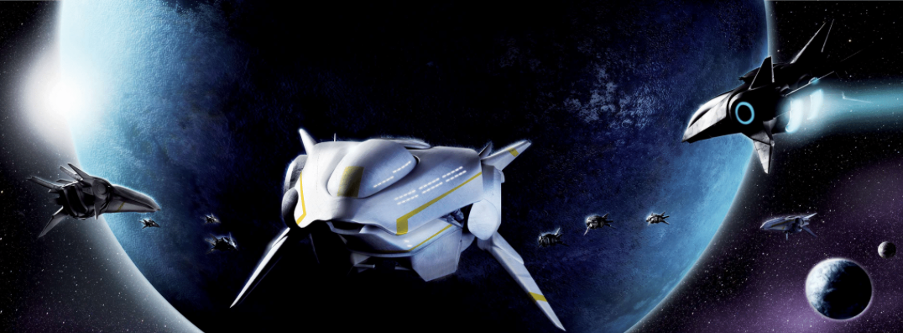
Officially, Vance serves as the Senior Fleet Liaison attached to the Magnus Breach Strategic Command. In practice, he is the architect behind countless operations conducted across the region. From hidden command centres, orbiting warships and mobile Minerva command platforms, Vance directs the flow of intelligence, fleet movements and rapid-response deployments throughout the sector. Few soldiers on the front lines know his name. Fewer still understand how many of their victories, and defeats, can be traced back to his decisions.
Unlike many senior Enforcer officers, Vance does not believe wars are won through bravery, honour or determination. Wars are won through information.
Every transmission intercepted, shipping manifest recovered, civilian report verified, orbital scan processed contributes to a constantly evolving strategic picture.
To Vance, each operation is a calculation. Every asset has a value. Every casualty has a cost. The question is never whether losses will occur, but whether those losses ultimately advance the wider objective. He has repeatedly authorised deployments and aggressive offensives that more cautious commanders would have rejected outright. Yet time and again, those actions have delivered results.
As tensions within the Magnus Breach continue to escalate, Vance has become increasingly convinced that the region stands on the brink of a conflict unlike any seen in decades. Fragmented intelligence reports, unexplained fleet disappearances and unusual activity throughout several border systems have all contributed to a conclusion that few are willing to accept.
Something is moving within the Breach.
Something large.
While others focus on local uprisings and isolated threats, Vance has begun repositioning Enforcer assets across the sector in anticipation of a wider war. Patrol routes have changed. Reserve forces have been quietly redeployed. Long-range reconnaissance missions have increased dramatically. To outside observers, these actions appear disconnected.
For this reason, he has taken direct command of strategic operations surrounding the Breach, deploying personally aboard a customised Minerva command platform whenever major engagements erupt. Protected by enhanced armour, reinforced shield emitters and enough communications equipment to coordinate entire fleets, Vance oversees conflicts unfolding both in orbit and on the ground simultaneously.
At his side is always an experienced battlefield adjutant, usually drawn from the forces currently engaged. Together they merge local observations with orbital intelligence, refining firing solutions and strategic assessments until the final moment. Under Vance's command, fleet weapons have been brought to bear within metres of friendly positions, their devastating firepower delivered with surgical precision.
As the Magnus Breach edges ever closer to war, that certainty may prove either the salvation of the sector... or the reason it burns.
The Curtain
A listening post beyond the Curtain ceased transmitting – a survey vessel failed to report its findings and merchant captains returning from the frontier spoke of strange sensor echoes and regions of space that felt unnaturally silent. Most incidents were logged, categorised and forgotten amongst the endless flood of reports that passed through Enforcer command networks each day.
Yet Wing Commander Silas Vance continued to revisit them, searching for hidden patterns and data bytes that could paint him a picture of the upcoming conflicts.
The Curtain had always been a wound in the galaxy's edge, a region of darkness that seemed to resist understanding. Navigators avoided the area entirely, unless their increased demand of payment were met. Explorers crossed it only when necessary and usually only because of fear of retribution or promise of exclusive bounties. Across centuries it had swallowed ships, colonies and entire expeditions, leaving behind little more than rumours and fragmented records.
Now something appeared to be stirring within it.
No single report confirmed the threat. No definitive evidence existed. Fragments of data could be explained away on their own. Yet when Vance viewed them together, a shape began to emerge from the unknown.
One that grew more difficult to ignore with each passing cycle. As frontier worlds increased their requests for military support, Vance began focusing on the systems nearest the Curtain. He reviewed fleet movements, trade routes, orbital infrastructure and centuries-old strategic assessments. Thousands of simulations were run. Most produced different outcomes, although a handful did not.
Repeatedly the same names surfaced, the same worlds within the cluster.
Gladium.
Myorcix.
Thern.
Dalkanus.
Why these worlds appeared so often remained unclear. There were other systems with greater populations. Others possessed richer resources or stronger defences and by conventional logic, they should have been the more valuable targets. Yet the simulations continued to return the same result as markers along a path.
Or stepping stones across a river.
Vance never publicly claimed to know what was coming. Such certainty would have been dishonest. His reports would focus on the facts, and what the data points led him to conclude.
He became increasingly convinced that events were already in motion. The frontier worlds were not isolated locations but pieces of a larger design, one whose full shape remained hidden beyond the darkness of the Curtain. His reports reflected this ambiguity.
"If hostile incursions occur, the planet will fall," one assessment stated, "the strategic significance of these systems may exceed currently accepted projections. We cannot afford to lose the assets within the holds"
Reconnaissance surveys were requested. Contingency plans were drafted and quietly distributed to commanders who would follow Vance's judgement without question. As months passed, his attention increasingly settled upon a single world.
Dalkanus. An ancient world the Forge Fathers had operated on for centuries, would become the focal point of the campaign ahead of him.
The reasons were difficult to articulate, even to himself. Every model, projection and strategic exercise seemed drawn toward it. Some ended in victory, yet most ended in catastrophe. Some envisioned battles lasting days, others mere months. Yet regardless of outcome, Dalkanus remained the point upon which everything turned.
The world sat at the centre of converging possibilities.
When the Magnus Breach finally tore open and the first confirmed reports emerged from beyond the Curtain, many commanders were shocked by the scale of the unfolding disaster.
Silas Vance was not.
Not because he had foreseen the future. He had spent years staring into the darkness and had come to a simple conclusion: Whatever emerged from the Trench, its true objective had never been the worlds it consumed along the way.
The decisive battle lay elsewhere. Somehow, in ways he could not yet fully explain, all roads seemed destined to lead to Dalkanus.
Silas will first be available to 3D Print during our Global Campaign - and will be playable in Firefight with Rules appearing in the Companion soon.
Join us next week as we introduce some more characters to the Global Campaign, in the meantime start building your armies and Strike Teams for Firefight, Deadzone, and Epic Warpath!
Cleric