How to Play Halo: Campaign Evolved – The Board Game
16th Oct 2026
Dan Mapleston

1-2 Players |Ages 13+ | 30+ Mins
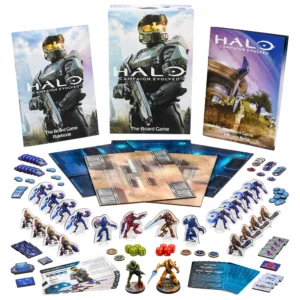
In our previous blog, we took a look at what comes in the box for Halo: Campaign Evolved - The Board Game. Or you can catch up with the video version below!
Today we're going to take a top-level view of the core mechanics that turn a joyous box of card and plastic goodness into the beaches of The Silent Cartographer, the frozen corridors of Assault on the Control Room and other classic Halo missions against the Covenant.
And before we do, here's the short version of exactly why you'll love Campaign Evolved - The Board Game:
- Play through the iconic Halo missions you remember, now on your tabletop
- Become the Master Chief in a campaign against the Covenant, either solo or versus a friend
- Enjoy tactical battles that capture the feel of Halo's legendary combat
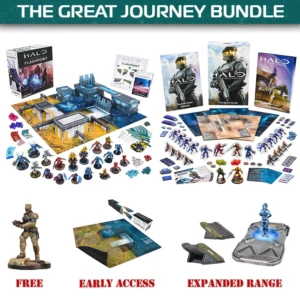
- Use the included miniatures in Halo: Flashpoint, and bring bonus missions and new enemies from Judgement into the board game
But most importantly of all...it's just really, really good fun!
Introduction to the Rules
One of the strengths of Campaign Evolved - The Board Game is that you don't need to learn a big rules system before you can get started. Most of the game is built on a few straightforward concepts and once you understood those, everything from firefights with Grunts to battles against Elite Zealots follows the same basic structure.
Note: units may have special rules or abilities that come into play for additional theme and flavour - the below examples are just to explain the core ideas.
Each mission places you in control of the Master Chief as he fights through the Covenant to complete a specific objective. Sometimes that objective is reaching an extraction point. In other missions, you'll be rescuing survivors, securing Forerunner installations or battling through waves of reinforcements. Remember to play the objective!
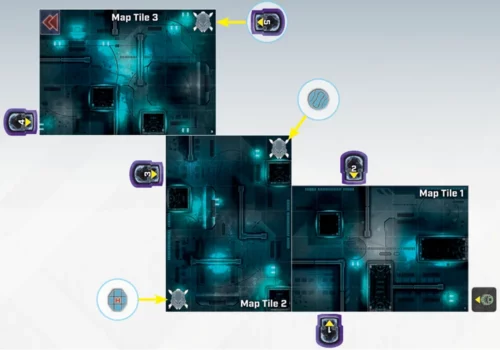
Before you start each scenario, the mission book will tell you what is happening, how to set up the map (e.g. with a diagram like the one below), the enemies you'll be facing, and any special conditions taking place in the game you are about to play.
Rounds and Turns
At the start of each round, the Master Chief takes his turn. Once he's finished, the Covenant activate. After both sides have acted, a new round begins. Simple!
The Master Chief's turn begins with shield regeneration. If he has lost shields, he recovers one Shield token, up to his normal maximum. Anyone familiar with the Halo videogames (or Halo: Flashpoint!) will immediately recognise the importance of this mechanic. Finding a moment to break line of sight and let your shields recover can completely change the outcome of a battle...
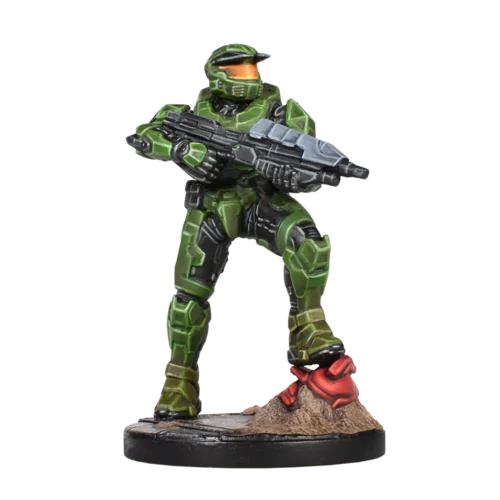
After regenerating shields, the Master Chief may then perform four actions: two Move actions and two Shoot/Fight actions in any order. He could advance, fire twice, then retreat behind cover. He could move into close combat and focus entirely on melee attacks. Or he might spend a turn repositioning to secure a weapon pickup before engaging the enemy.
Each action is resolved completely before moving on to the next.
Movement
Movement itself is also simple. Models move from space to space on the map tiles up to their Move value and cannot pass through walls, terrain, or other models.
So a unit with a Movement value of 4 could move as per below:
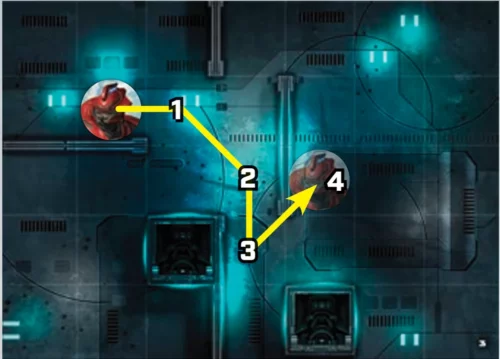
While the rules for movement are straightforward, positioning quickly becomes one of the most important decisions in the game. A single square's difference can determine whether an enemy is visible, whether they benefit from cover, or whether a melee attack becomes possible.
Line of Sight and Cover
This importance of positioning becomes clear when dealing with line of sight. Before making a shooting attack, a target must be both in range and visible. If terrain or another model partially obscures the target, that target is considered to be In Cover and gains an additional defence die when attacked. If line of sight is completely blocked, the attack cannot be made at all.
Ranged Attacks
Once a target has been chosen, combat is resolved using opposed rolls. Shooting attacks provide a good example of the system that runs through the entire game.
The attacker rolls three dice, or four dice if they have clear line of sight to the target. The defender rolls three dice, gaining a fourth die if they are in cover. Successes are counted by comparing each die result to the relevant stat value found on that unit's stat card. A model with a Shoot value of 4+, for example, scores a success for every die showing a 4, 5 or 6.
After both sides have rolled, compare the number of successes. If the attacker scores more successes than the defender, the attack succeeds. If the scores are tied, or the defender scores more successes, the attack has no effect.
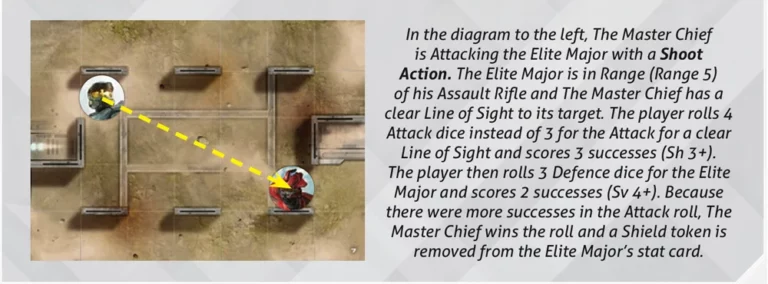
A typical exchange might see the Master Chief firing at an Elite Major in the open...
Melee Attacks
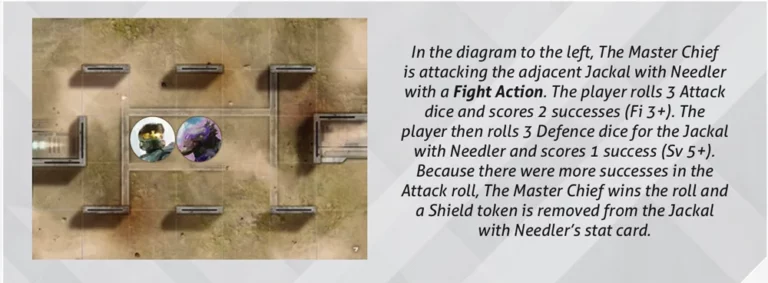
Melee combat follows almost exactly the same procedure. The attacker must be adjacent to the target and uses the Fight value on their card instead of their Shoot value. Both players roll their dice, count successes and compare results. If the attacker scores more successes, the target loses a shield or suffers damage. Because shooting and fighting share the same resolution system, you'll get comfortable with how combat works very quickly.
A simple example would be the Master Chief moving adjacent to a Jackal before making a Fight action...
Shields and Damage
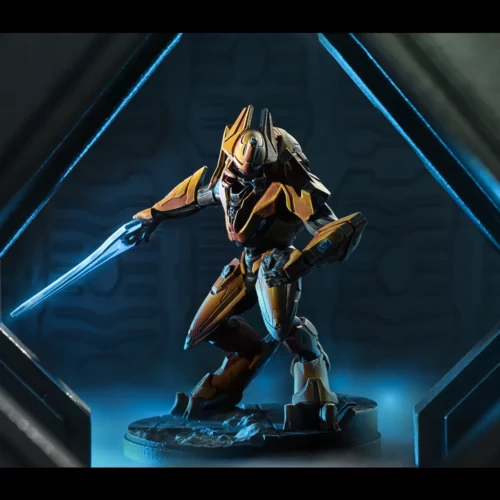
Shields sit at the heart of the game's combat system. Successful attacks remove shields before they ever deal damage. As a result, many engagements have the familiar (dare we say classic?) Halo rhythm...strip the enemy's shields, then finish the job before they can recover and come after you...
Most Covenant troops are removed from play as soon as they take damage, whereas the Master Chief is more resilient. The first time he suffers damage, his card flips to its Injured side rather than being removed. If he later takes further damage while injured and without shields, he is defeated.
Taken some big hits and need a pick-me-up to finish the mission? Health Packs found throughout the campaign can restore John-117 to full effectiveness...if you can reach them!
Weapons & Power-Ups
As missions progress, the battlefield offers opportunities to pick up new equipment. Weapons such as the Needler, Plasma Pistol, Sniper Rifle and M41 SPNKr all introduce their own special rules while still using the core combat mechanics.
For example, the Needler can generate additional attack dice, Plasma Pistols can strip shields with charged shots, and other weapons introduce other tactical options without significantly increasing complexity.
The same is true of power-ups. Moving onto an Overshield or Active Camouflage pickup immediately grants new abilities that can dramatically alter the next few turns. Health Packs, as mentioned above, provide a vital recovery option when the Master Chief is injured.
Covenant Activations
Once the Master Chief has finished, the Covenant take their turn - either controlled by a second player of the game's rules system.
Depending on the mission, fresh reinforcements may arrive before enemy activations:
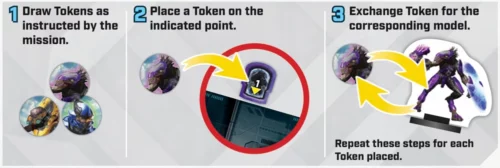
Once deployed, Covenant models follow a behaviour system driven by a series of simple conditions. Depending on their position and special rules, they'll attempt to (1) move into range, (2) gain line of sight, (3) attack the Master Chief and (4) seek favourable positions on the battlefield.
For example, an Elite that begins its activation with line of sight to the Master Chief will generally shoot first and then attempt to move to a position where it cannot be targeted in return. If no such position exists, it will try to move into cover instead.
The Medals System
One final system needs mentioning, and you're going to like this one: Medals!
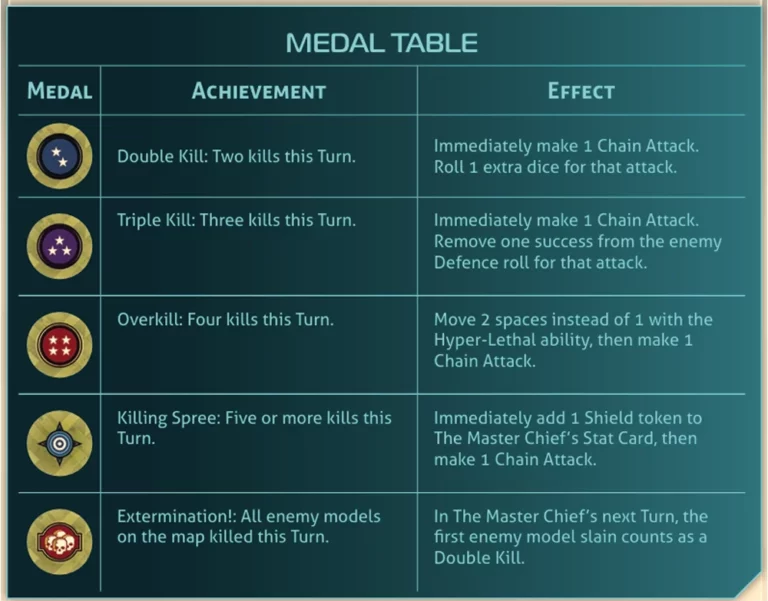
If the Master Chief eliminates multiple enemies during a single turn, he can earn rewards such as Double Kill, Triple Kill, Overkill and Killing Spree - if you've played enough Halo then your brain will have automatically read these in the 'announcer voice'.
Rather than being simple 'bragging rights' achievements, these medals grant immediate gameplay benefits, such as bonus movement and additional attacks.
Let's say that the Master Chief removes two Covenant models in a single turn. Earning a Double Kill immediately grants a Chain Attack, allowing him to make another free attack with an additional die. Well-planned turns can build rapidly from one kill into several...
Now You're Mission-Ready
And that's all the basics, right there. This combination of straightforward rules and mission-specific challenges runs throughout the campaign. The missions introduce new environments, objectives, reinforcement patterns, power-ups and enemy types, but they all build on the core rules you've seen above.
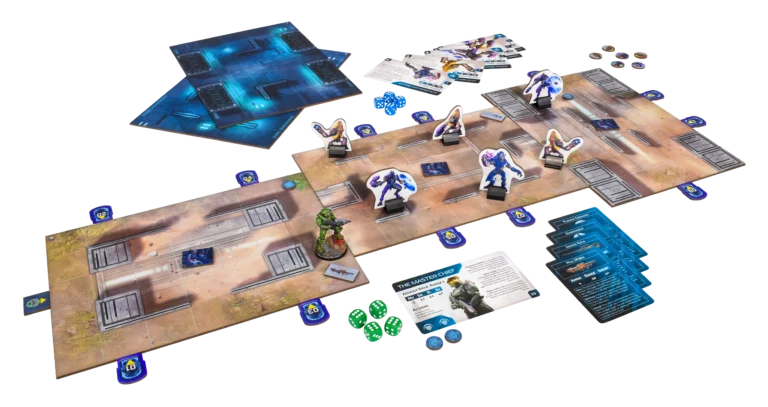
Crack open the box and you'll quickly be ready to tackle the battles that await across Installation 04. And did we mention you can run each scenario on Legendary Mode?
There's a whole heap of fun to be had with Campaign Evolved - The Board Game, and we can't wait for you to get your hands on it. You can pick it up solo, or as part of a Covenant bundle with the latest Halo: Flashpoint goodies - links below.
Enjoy!